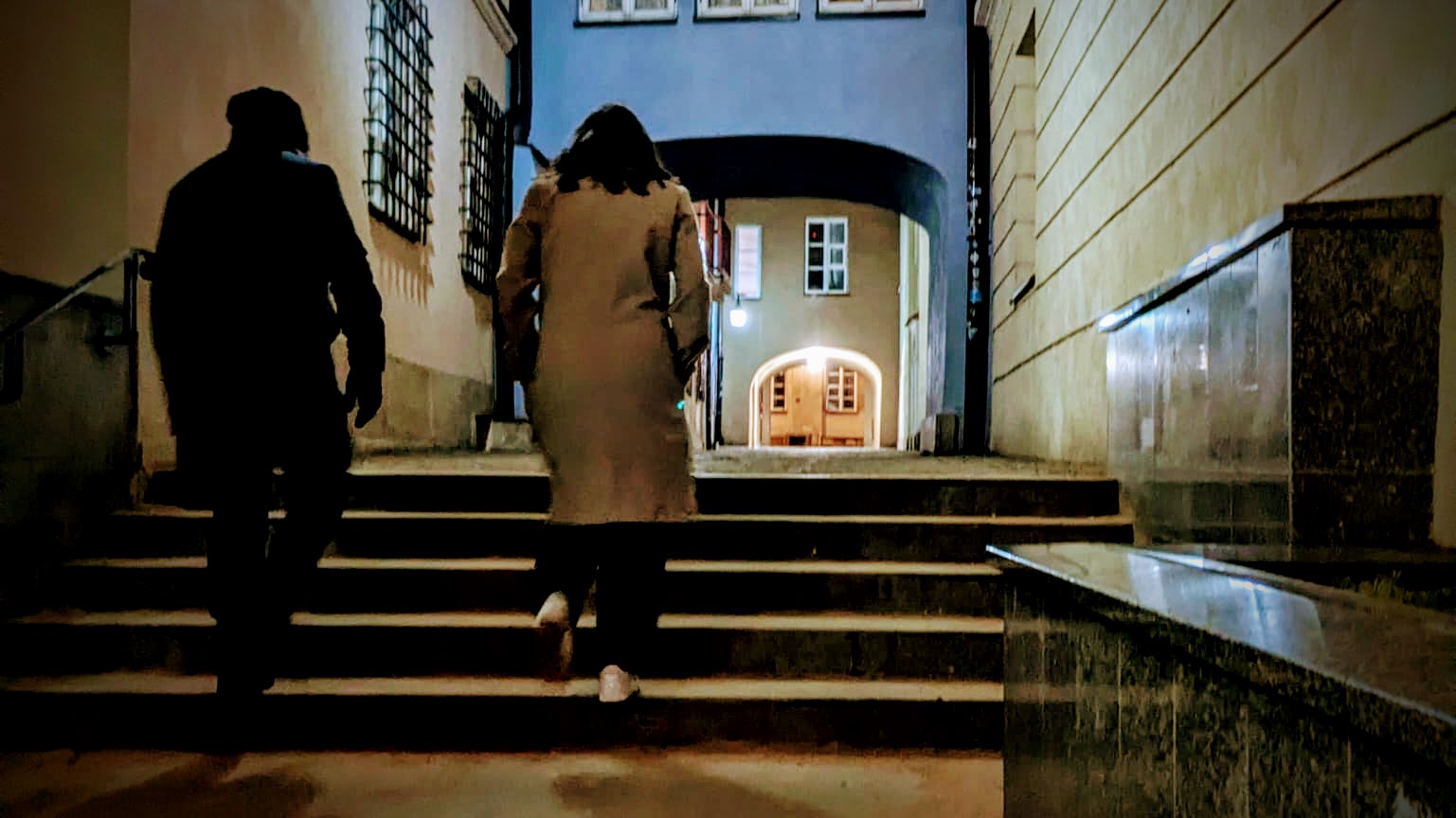
Last week in Warsaw I found myself walking through the dark streets discussing systems thinking and customer problems with a colleague.
Which would normally be a fairly standard evening for the work we do.
Except my brain suddenly reminded me of something slightly ridiculous.
I used to feed this person… and burp them.
That’s when the conversation suddenly felt mildly surreal.
Amy works with us at KOAP. She has done for over five years now. A lot of our clients won’t know her name, but a surprising amount of the thinking that ends up in our work has her fingerprints on it. Data patterns, insights, creative angles the rest of us hadn’t seen.
She’s annoyingly good at it.
But I didn’t meet Amy through work.
I met Amy before she could walk.
Her mum, Karen, and dad, Mark, were our neighbours and friends. Karen was Stella’s best friend. So Amy grew up in that slightly chaotic orbit of shared houses, shared gardens, children running between homes and adults pretending they were still young enough to host parties that went on far longer than they should.
If you’ve ever lived in that kind of neighbourhood you’ll know what I mean.
The sort where broken garage doors, damaged wooden fences and slightly annoyed neighbours are usually the aftermath of a “good night”. Where someone inevitably shouts “just one more song” at two in the morning.
Amy was part of that world.
I remember barbecues, birthday parties, football in the garden, tennis games, and one particular moment that always makes me laugh. A 2am singalong where half the adults were reliving the 80s with great enthusiasm… and this small girl who technically wasn’t even alive in the 80s somehow knew every single word.
That was Amy.
Which makes it slightly strange to realise that the same person is now walking beside me in Warsaw discussing systems thinking and quietly dismantling parts of my argument.
Quite confidently as well.
That’s when you realise something interesting about getting older.
At some point the people you once looked after become people you learn from.
And if you’re paying attention, that’s actually one of the best parts of life.
There’s a temptation as you get older to assume experience equals wisdom.
Sometimes it does.
But the world moves quickly. The generation that grew up with data, technology and a different way of seeing patterns often notice things we simply didn’t learn to look for.
Amy sees systems everywhere.
Where I might look at a customer problem and see behaviour, relationships and emotion, she often sees structure. Signals in data. Patterns in how decisions move through organisations.
It’s a different lens.
And when those lenses combine, the thinking gets better.
That’s what struck me walking through Warsaw.
Not that I was teaching someone younger.
But that I was learning alongside them.
The other thing this made me realise is how much good work is shaped by people you never see.
The person presenting the idea is rarely the only mind behind it. There are always hidden contributors. People shaping ideas, spotting patterns and quietly making the rest of us look a bit more intelligent than we probably are.
Amy is one of those people for us.
The quiet brain in the background helping shape the thinking.
But there’s another layer to this story that stayed with me as we walked those streets.
Karen.
Amy’s mum.
Karen fought a long battle with cancer before she passed away. Anyone who has been through that kind of loss knows the strange mixture of grief and growth that follows. Funerals, tears, and the moment when everyone suddenly realises life has moved forward whether we were ready or not.
Walking through Warsaw, listening to Amy explain a way of looking at a customer problem that hadn’t occurred to me, I had one of those quiet thoughts.
Karen would have absolutely loved this moment.
Seeing the woman her daughter has become. Smart, confident, creative and perfectly capable of challenging someone three decades older than her.
Karen isn’t here to see that.
But I am.
And that carries a certain quiet privilege.
Sometimes the unexpected gift of getting older is simply being around long enough to watch the children of your friends become remarkable adults.
There’s one final thing this experience reminded me of.
We all carry scripts in our heads about people.
Who they are. What they’re capable of. The version of them we first met.
The problem is people keep growing.
If you hold too tightly to the old script, you miss who they’ve become.
Organisations do this all the time. We freeze people in the version of them we first encountered. The intern. The junior analyst. The quiet one in the corner.
But people change.
Last week in Warsaw I was reminded of that.
Because the baby I once fed and burped is now walking beside me arguing about systems thinking and customer complexity.
And doing a very good job of it.
Which, if I’m honest, is both slightly disorientating and completely brilliant.
Life moves on whether we notice it or not.
Sometimes, if we’re lucky, we get to walk alongside the people we once watched grow up and discover they’ve become people worth learning from.
And somewhere, I suspect, Karen would have been smiling at that conversation.